Europe’s new political advertising rules were meant to protect democracy. But by driving paid political campaigns off major platforms, Brussels may have created a system where outrage has a built-in advantage — and reasonable voices struggle to be heard.
Imagine two politicians trying to reach voters.
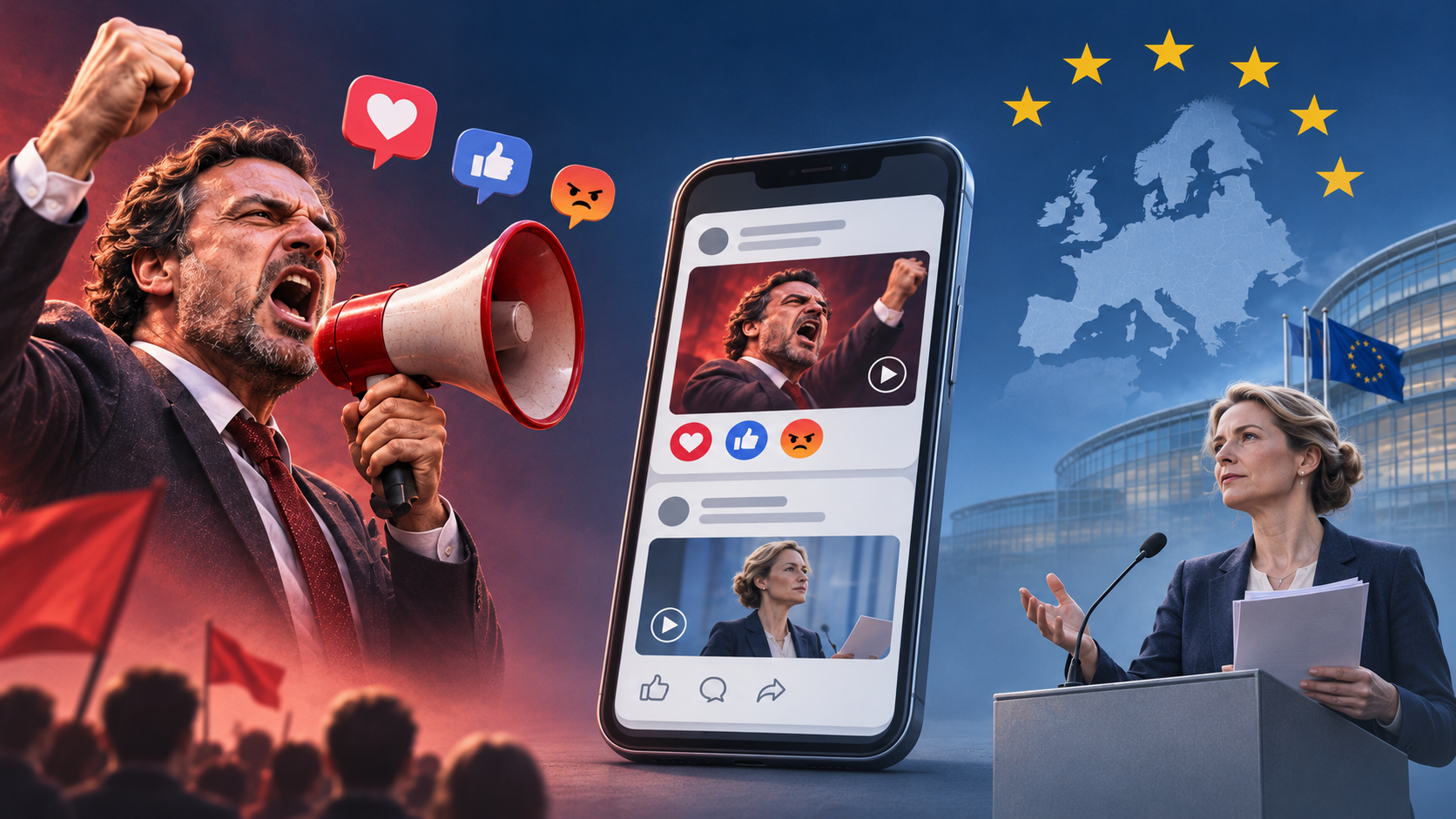
One publishes a thoughtful proposal on how to address Europe’s housing crisis, complete with practical solutions and economic arguments. The other posts a furious 30-second video blaming the political establishment for everything that’s wrong with the country.
A few years ago, both could pay Facebook or Instagram to put their messages in front of voters. Today, in the European Union, neither can.
But there’s a catch: The second politician might not need to.
In an online environment where engagement determines visibility, anger, confrontation and emotional outrage can generate enormous organic reach. A measured policy proposal, however reasonable, may struggle to escape the politician’s existing audience.
And that raises an uncomfortable question for Brussels: Has Europe’s attempt to protect democracy inadvertently tilted the political playing field toward those who shout the loudest?
When Brussels changed the rules, Big Tech walked away
On October 10, 2025, the EU’s Regulation on the Transparency and Targeting of Political Advertising came into full effect.
The legislation was designed to address legitimate concerns about election interference, opaque campaign financing and the misuse of personal data for political microtargeting.
It required greater transparency about who pays for political advertising, how much they spend and how audiences are targeted.
What it did not do was ban political advertising outright.
Instead, Meta and Google decided that complying with the new requirements would introduce too much complexity and legal uncertainty. Both companies withdrew political advertising services from their platforms in the EU.
The result was a fundamental change in how politicians, parties and advocacy organisations could communicate with European voters.
Previously, a political campaign could use a modest advertising budget to introduce its ideas to thousands of people who might otherwise never encounter them.
Today, that option has largely disappeared from some of Europe’s most influential digital platforms.
Political speech itself remains permitted. Politicians can post, debate, criticise and campaign organically.
They just can’t pay to ensure their messages reach people beyond their existing audiences.
And that distinction matters far more than policymakers may have anticipated.
The algorithm doesn’t reward reason. It rewards reactions.
Social media platforms are not neutral public squares where every argument receives an equal opportunity to be heard.
Their recommendation systems are designed around signals such as engagement, attention and user behaviour.
And research suggests that emotionally charged political content can benefit from those systems.
A 2025 study published in PNAS Nexus found that X’s engagement-based ranking algorithm amplified more emotionally charged and politically hostile posts than a chronological feed would have done.
That finding does not establish that every platform works identically. But it illustrates a fundamental problem: What attracts attention is not necessarily what contributes to informed democratic debate.
Consider what this means for political competition.
A politician offering a complicated but potentially effective pension reform has to explain trade-offs, costs and long-term consequences.
A rival can simply publish an angry video accusing the government of abandoning pensioners.
The first message requires attention and consideration. The second invites an immediate emotional response.
Under the old system, both could potentially buy visibility. Under the new reality, their organic distribution depends heavily on how audiences respond — and how algorithms interpret those responses.
This is not to suggest that populist movements have a monopoly on emotional messaging, or that mainstream parties are always more reasonable. Nor does it mean that every viral political message is misleading.
But it does suggest that removing paid distribution without addressing the incentives of organic distribution could produce unintended consequences.
The paradox of political advertising bans
There is another irony.
Political advertising, for all its problems, came with increasingly sophisticated transparency mechanisms.
Meta’s political advertising library, for example, allowed journalists, researchers and citizens to examine campaign messages and advertising expenditure.
Organic political content does not come with equivalent information about why a particular message was amplified, to whom or through which recommendation mechanisms.
And the restrictions have not necessarily eliminated undisclosed paid political influence.
Research published by the Civil Liberties Union for Europe in May 2026 found that political advertising continued to circulate around Hungary’s parliamentary election despite the platform bans, including through proxy pages, misclassified advertisements and other methods.
An October 2026 investigation by Romanian civil society researchers similarly documented hundreds of advertisements containing political messages, many without the corresponding political labels.
These findings do not prove that the new rules have increased support for populist parties. But they raise a troubling possibility: Compliant political campaigns have lost a legitimate communication channel, while less transparent forms of political promotion continue to find their way onto people’s screens.
The supposed solution may have removed some of the most visible and accountable political messaging while leaving other forms of influence harder to scrutinise.
Did Europe solve the wrong problem?
None of this means the old system was perfect.
Political advertising could be exploited by wealthy interests, sophisticated manipulators and foreign influence operations. Unrestricted microtargeting created serious risks for privacy and democratic accountability.
The EU had good reasons to intervene.
But there is an important difference between regulating political advertising and creating conditions in which major platforms decide that offering it is no longer worthwhile.
The former seeks to make political communication more accountable. The latter risks making legitimate paid political communication less accessible.
And the consequences may not be evenly distributed.
Established politicians with large followings can continue communicating with audiences they have spent years building. Political movements with highly engaged supporters can generate significant organic distribution. Influencers and personalities skilled at provoking reactions can turn controversy into visibility.
New political movements, smaller parties and candidates whose appeal rests on detailed policy proposals may face a different challenge: How do you introduce an idea to voters who have never heard of you, when you cannot pay to reach them and your content isn’t designed to go viral?
Paid advertising was never a guarantee of fairness. But it offered one route to public attention that did not depend entirely on algorithmic popularity.
Removing that route changes the competitive dynamics of political communication.
Whether the change disproportionately benefits populist parties remains an empirical question — one that deserves serious investigation rather than assumptions.
The question Brussels should be asking
More than a year after Europe’s political advertising rules took effect, their consequences deserve scrutiny.
Researchers should be examining how political reach has changed, which types of messages gain visibility, how campaign strategies have adapted and whether voters are now being exposed to a narrower or more emotionally charged range of political arguments.
Crucially, those questions should be examined across countries, platforms and political ideologies.
The objective should not be to restore unrestricted political microtargeting or abandon transparency requirements. It should be to understand whether the current system actually supports the pluralistic political debate that European lawmakers intended to protect.
Because democracy depends on more than preventing manipulation.
It also depends on citizens being exposed to competing ideas — including those that do not immediately provoke anger, excitement or outrage.
Europe set out to make political influence more transparent. It may instead have made political visibility more dependent on algorithms that reward emotional engagement.
And if that is the case, the biggest beneficiaries may not be those with the best ideas, but those who are best at capturing attention.
Brussels wanted to stop money from quietly determining which political messages voters see.
It now needs to ask whether it has handed that power to something even less transparent: the algorithm.
*
Footnote – I would love to advertise link to this article to people in Brussels who travel often (in hopes of reaching policymakers), but in this new reality it wouldn’t be possible, because theme of this post falls under the undesired category thus it’s not promotable.
This can be rectified – roll back to previous rules, forbid any kind of advertising until political advertising is allowed again or talk to the tech giants about solving this and find some middle ground.